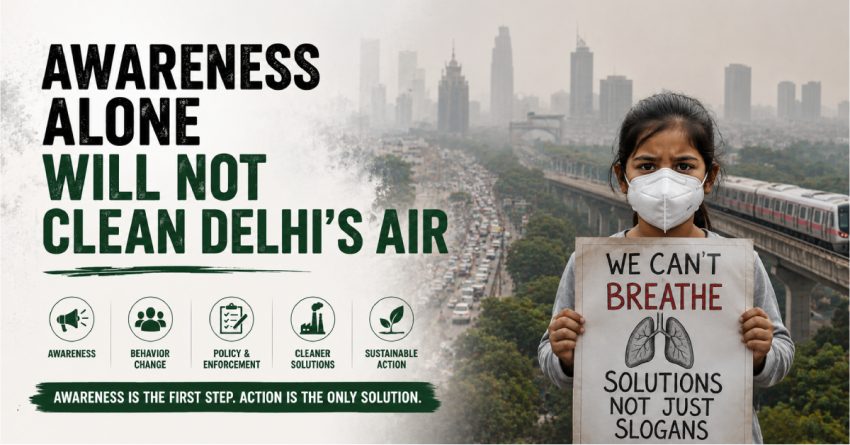
Over the past few years, awareness around air pollution in Delhi has grown significantly.
People now check AQI levels regularly, news channels discuss pollution trends, health experts warn about the dangers of PM2.5 exposure, government agencies continue introducing mitigation measures and stronger environmental monitoring systems, etc.
There is no shortage of information.
And that is important.
Awareness is always the first step toward change. But awareness alone is not enough. Knowing that Delhi has an air pollution problem does not solve it. Understanding the risks does not automatically reduce exposure. Recognising the urgency does not, by itself, create cleaner air.
This is where one of the biggest gaps in environmental action becomes visible. Awareness creates conversation. Action creates change.
Why Awareness Matters
Public awareness has played a critical role in bringing air pollution into mainstream discussion. It has helped people understand the seriousness of poor air quality, it has encouraged policy discussions, and it has increased public pressure for cleaner environmental practices.
Without awareness, environmental challenges often remain invisible and invisible problems rarely receive meaningful attention.
This progress matters, but awareness was never meant to be the final destination. It is the starting point.
The Problem With Awareness Alone
Despite growing awareness, Delhi continues to face serious air-quality challenges.
Why?
Because information alone does not transform urban systems. A city does not become cleaner because people understand pollution statistics.
Cleaner air requires measurable intervention, implementation, and accountability.
This is where many environmental efforts fall short. Too often, action remains symbolic rather than structural.
Temporary reactions are introduced during peak pollution periods. Seasonal concern rises and falls. Short-term initiatives create visibility but not sustained environmental improvement.
The result is a cycle of discussion without long-term transformation.
Moving From Conversation to Implementation
If Delhi is to make meaningful progress, the focus must shift from awareness campaigns alone to practical environmental systems.
This means designing solutions that are:
- Measurable
with visible performance indicators - Monitored
with long-term accountability - Scalable
with potential for city-wide impact - Designed for local relevance
to address real exposure points
Cleaner air cannot depend on temporary outrage; it must be built through systems that function consistently over time.
What Comes Next?
This raises an important question.
If awareness alone is not enough, what kind of action actually works?
This is where environmental strategy becomes critical. Not every intervention creates meaningful impact.
Not every plantation effort improves urban air quality, nor does every environmental campaign deliver measurable results.
The challenge is not simply doing something, it is doing the right thing.
Where CAC Green Fits In
At CAC Green, we believe environmental progress must move beyond conversation. Awareness must lead to action, and action must lead to measurable outcomes.
Through monitored, design-led environmental interventions, we aim to support practical clean-air solutions that create real urban impact. Because Delhi does not need more awareness alone. It needs systems that work. And that begins by asking a harder question: Are we ready to move beyond awareness and build solutions that deliver measurable change?