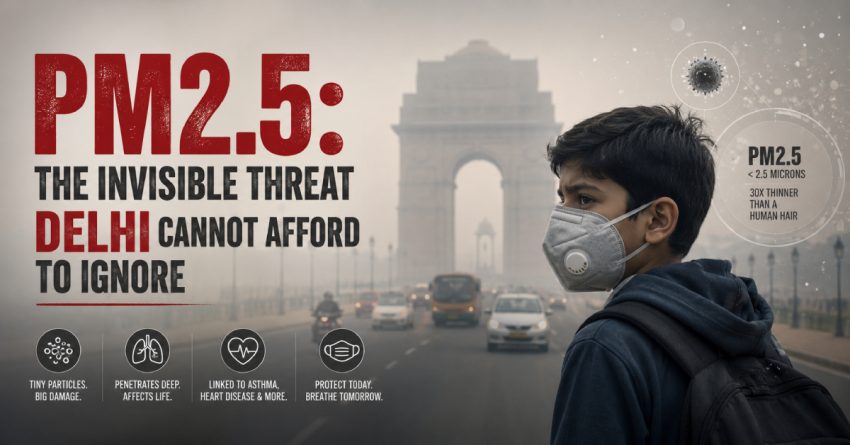
When we think about air pollution, most of us picture thick smog covering the skyline.
We notice the haze, we complain about poor visibility, we check AQI levels, etc.
But some of the most dangerous pollutants in the air cannot be seen at all.
One of the biggest hidden threats in Delhi is PM2.5 — microscopic particles that quietly affect human health every single day.
And while the term is often mentioned in air quality reports and news updates, very few people fully understand what it means or why it matters.
The truth is simple: PM2.5 is one of the most serious public health challenges facing urban India.
What Exactly Is PM2.5?
PM2.5 stands for particulate matter that is 2.5 micrometers or smaller in diameter.
To understand how small that is, these particles are around 30 times smaller than the width of a human hair.
Because of their extremely small size, they can bypass the body’s natural defense systems.
Instead of being filtered out through the nose or throat, PM2.5 particles travel deep into the lungs and, in many cases, enter the bloodstream.
That is what makes them so dangerous.
They are not just floating in the air around us.
They are entering the body.
Why Should You Care?
Because exposure to PM2.5 affects far more than breathing.
Scientific studies have linked prolonged exposure to fine particulate matter with:
- Respiratory illnesses
- Reduced lung function
- Asthma complications
- Cardiovascular disease
- Increased risk of stroke
- Long-term public health complications
This means poor air quality is not simply an environmental inconvenience; it is a direct threat to public health.
Children, senior citizens, outdoor workers, and individuals with pre-existing health conditions are especially vulnerable.
But the reality is that everyone living in polluted urban environments is affected.
Why PM2.5 Is a Serious Challenge for Delhi
Delhi continues to face sustained exposure to PM2.5 due to multiple urban pollution sources.
These include:
- Vehicular emissions
- Road dust
- Construction activity
- Industrial emissions
- Waste burning
- Weak urban green buffering
These pollutants remain present throughout the year, even when they are not visible.
This is why Delhi’s air challenge cannot be treated as a seasonal issue.
Recent government efforts to strengthen air-quality monitoring, tighten pollution control norms, and implement year-round mitigation measures reflect growing recognition of this reality.
This shift is important because PM2.5 cannot be managed through short-term emergency action alone; it requires continuous intervention.
What Delhi Needs?
The solution is not awareness alone.
Awareness is where action begins — not where it ends.
Delhi needs practical, measurable environmental systems that reduce exposure at the local level.
This includes:
- Better urban green infrastructure
- Cleaner mobility systems
- Stronger dust-control enforcement
- Continuous air-quality monitoring
- Design-led environmental interventions
Clean air must be treated as essential urban infrastructure.
Where CAC Green Fits In
At CAC Green, we believe environmental action should be visible, measurable, and scalable.
Through monitored urban greening and clean-air-focused interventions such as Oxygen Wall systems, we aim to support solutions that reduce local pollution exposure and strengthen environmental resilience.
Because cleaner air should never depend on seasonal luck.
The Reality We Must Face
PM2.5 may be microscopic.
But its impact is massive.
The more we understand it, the better equipped we are to design cities that actively protect public health.
Cleaner air begins with awareness.
But it becomes reality through action.