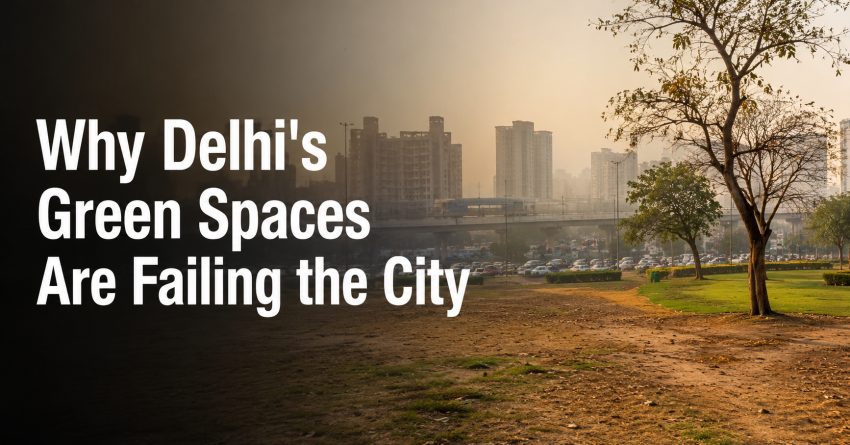
Delhi is not short of trees.
The city has parks, medians, roadside plantations and green belts across hundreds of kilometres. On paper, it looks reasonably green. On the ground — and in the air — something is clearly not working.
The problem is not quantity. It is design.
Green Space Without Purpose Is Just Decoration
Most of Delhi’s urban greening has been driven by aesthetics and optics — parks that look pleasant, medians that appear well-maintained, sapling drives that generate good photos.
Very little of it has been designed with a specific environmental function in mind. Trees are planted where there is space, not where they are needed. Species are chosen for availability, not performance. Maintenance is inconsistent, survival rates are rarely tracked, and outcomes are rarely measured.
The result is green cover that looks functional but largely isn’t.
What a Smarter Urban Forest Actually Means
Designing smarter urban green spaces means starting with a question: what do we need this green space to do?
In a city like Delhi, the most urgent answers are:
- Reduce localised particulate exposure near roads, schools and hospitals
- Lower surface temperatures in dense urban corridors to reduce heat and ozone formation
- Stabilise exposed soil and road margins to prevent dust resuspension
- Sequester carbon in a way that can be verified and reported
Each of these functions requires different species, different placement, different structure. A park designed for leisure looks very different from a green barrier designed to filter road-level pollution. Both have value — but they are not interchangeable.
The Three Things Most Plantations Get Wrong
- Wrong location: Trees planted where space is available, not where impact is greatest. A park in a low-traffic residential area does far less for air quality than a green barrier along a school road.
- Wrong species: Fast-growing, easy-to-source species that look green but perform poorly as pollution barriers. A single dense native shrub can outperform ten decorative saplings.
- No structure: Single-row planting instead of multi-layer systems. A three-layer green barrier — tall canopy, mid shrubs, ground cover — is not just aesthetically different. It is functionally different in ways that matter significantly for pollution reduction.
What Designing for Function Looks Like
The Oxygen Wall programme by CAC Green is built around exactly this principle — designing green installations for a specific, measurable function rather than a general green outcome.
Every installation begins with a site assessment. Location is chosen based on pollution exposure and vulnerable populations nearby. Species are selected for their performance in that specific environment. Structure is designed as a layered system. Survival and outcomes are monitored.
Delhi does not need more green spaces that look good. It needs green spaces that work — and a clear, honest way to know the difference.
To explore what a function-led green installation could look like for your organisation or location, write to info@cacgreen.org or visit www.cacgreen.org